Image source: Internet (Please contact us if you find any copyright infringement)
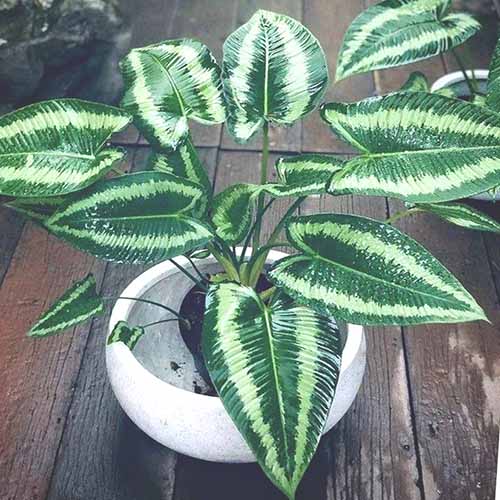
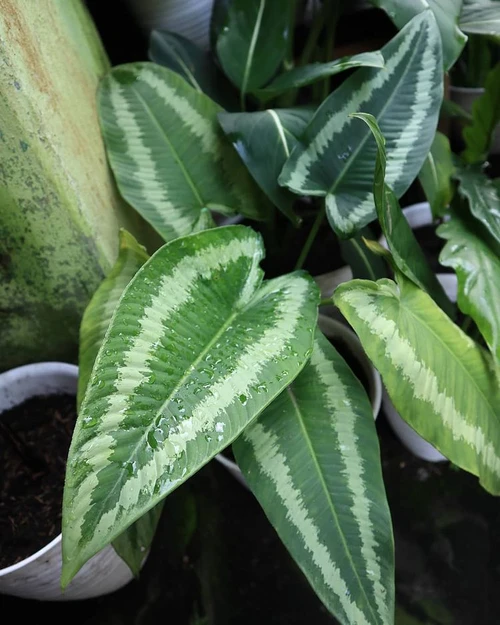
Homalomena Schismatoglottis
Homalomena Schismatoglottis has glossy, heart-shaped green leaves, creeping stems, prefers partial shade and high humidity, and is easy to care for.
Note: The above information is only relative, the living conditions of the tree also depend a lot on other objective factors.
How to grow and care for Homalomena Schismatoglottis
Homalomena Schismatoglottis Plant Growing Difficulty

Difficulty: 2-3/6
Homalomena Schismatoglottis is great for beginners or busy people because:
✅ Tolerates partial shade well, does not require strong light
✅ No need to water too often
✅ Grows well in humid tropical interior conditions
Soil for growing Homalomena Schismatoglottis
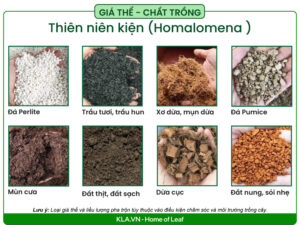
Homalomena Schismatoglottis has rhizomes rather than taproots, so it needs loose, well-drained soil that remains lightly moist around the roots.
📌 Recommended soil formula: ✅ 1 part humus or light loam
✅ 1 part coconut fiber or peat moss (moisture and nutrition retention)
✅ 1 part perlite or burnt rice husk (increases ventilation)
✅ 1 part pine bark chips or pumice (helps with drainage and prevents compaction)
🚫 Don't: hard, water-retaining soil, or clay-rich mother garden soil
💡 Notes when planting:
- The pot must have a drainage hole at the bottom.
- Apply organic fertilizer (worm castings, fish manure or slow-release fertilizer) 1–2 months/time
- After a year, the soil should be changed to avoid mineral salt accumulation.
Suitable light for Homalomena Schismatoglottis

📌 Lighting details: ✅ Best: diffuse light, such as near an east or north facing window, or in light shade
✅ Withstand: Low light indoors, but leaves will be small, pale in color, the plant will take a long time to grow new leaves
🚫 Absolutely avoid:
- Direct sunlight, especially midday or afternoon sun from the West/Southwest direction
- Place the plant near a hot light source like a halogen lamp — it can easily burn or dry out the leaves.
💡 Special Note:
- New leaves are small, have curled edges or change color → may be due to lack of light
- If grown in a dark room without windows → use LED plant growing lights, place 30-40 cm away from the plant, light 10-12 hours/day
📍 Ideal location:
- Next to the window, use thin curtains, 0.5–1.5m distance if the door faces South
- Grow in a room with diffused natural light, avoid harsh sunlight
- Do not place near high heat sources
The ideal temperature for Homalomena Schismatoglottis

🌿 Ideal temperature for Homalomena Schismatoglottis: 18 - 28°C
📌 Characteristic:
- Likes warm, humid environments, does not tolerate cold or sudden temperature changes
- Very sensitive to temperatures below 12 °C or above 32 °C
🚫 When temperature < 12 °C:
- The tree was damaged. cold shock, leaves become soft, yellow or fall off
- Roots lose the ability to absorb water
🚫 When temperature > 32 °C and humidity is low:
- Withered leaves, dry, brittle edges, crushed, slow to grow new leaves
📌 Care notes: ✅ Avoid cold wind from air conditioner, open windows at night
✅ Do not place the plant near the heater or stove.
✅ On hot days: increase humidity by misting, placing trays of water/pebbles, or using a humidifier
📍 Signs of affected plants:
- Too cold: leaves are soft, discolored, roots do not absorb water
- Too hot/dry: crispy leaf edges curl inwards, stem is not firm
Watering for Homalomena Schismatoglottis plants

Homalomena Schismatoglottis is native to the humid tropical forests of Southeast Asia, particularly Borneo and Malaysia. It thrives in high humidity and slightly moist soil, but is very sensitive to waterlogging, especially in the rhizome – which is prone to rot if waterlogged for extended periods.
📌 Watering principles:
✅ Water thoroughly, ensuring the entire pot is covered with water each time, making sure the water penetrates to the bottom of the pot and drains out through the drainage holes. This helps stimulate even root growth and prevents mineral salts from accumulating in the topsoil.
✅ Check soil moisture before watering: gently press your hand into the soil about 2-3 cm from the surface of the pot. Only water if it feels dry. You can use a moisture test strip or a moisture meter for accuracy.
✅ Reduce watering frequency during the rainy season, winter, or when the plant is growing slowly (usually from late autumn to early spring). When the plant produces fewer new leaves, the roots absorb water more slowly, so overwatering can cause root rot and silently kill the plant.
🚫 Never water according to a fixed schedule without checking the soil moisture first.
Unusual yellowing, softening, water spots or foul odors around the base of the leaves are warning signs that the roots are waterlogged – stop watering and check the soil and roots immediately.
📍 How many times a week should I water?
Hot season (Spring – Summer):
• Water 1–2 times per week, depending on light, wind, and drainage conditions of the pot. If grown in a terracotta pot or in a dry space, more frequent watering may be needed.
• In air-conditioned environments, humidity should be checked every 2–3 days.
Cold season (Autumn – Winter):
• Water only every 7–10 days, or even less frequently if the plant doesn't absorb water quickly. Prioritize consistent moisture levels over overly frequent watering.
💡 Water control tips:
-
Place the pot in a drainage channel or tray; avoid using a double pot without drainage holes (cachepot) unless you can carefully control excess water.
-
If you accidentally overwater, tilt the pot to drain the excess water, place it in a well-ventilated area, and check again after a few hours.
-
Using well-draining soil will help reduce the risk of root rot.
📌 Aquatic plant cultivation (less common but feasible):
Can be used for Selby if the rhizome is kept above water, not completely submerged. Use activated charcoal or lightweight rocks to stabilize the roots.
✅ Change the water 1–2 times/week
✅ Ensure good light and air circulation to prevent mold and algae
Humidity for Homalomena Schismatoglottis

Homalomena Schismatoglottis is a moisture-loving plant that thrives best in humidity levels between 60µm and 80µm. While it can adapt to moderate indoor humidity, it will grow more vigorously and have healthier, glossy leaves when raised in high-humidity conditions, especially during the dry season or when air conditioning is used.
📌 How to maintain the right humidity for Homalomena Schismatoglottis:
✅ Spray a light mist every morning, avoid spraying at night to limit the risk of fungus and disease.
✅ Place the plant on a tray of pebbles filled with water to create micro-humidity around the pot.
✅ Use a humidifier in the room when the air is dry.
✅ Planted with other tropical plants such as Calathea, Alocasia, helps increase natural humidity through transpiration.
The ideal pH level for Homalomena Schismatoglottis

Homalomena Schismatoglottis thrives in soil with a pH of 5.5 to 6.5 – slightly acidic. This pH range helps the plant absorb nutrients effectively, especially magnesium (Mg), calcium (Ca), and iron (Fe), supporting photosynthesis and foliage growth.
🌿 If the pH is lower than 5.0, the plant may be deficient in calcium and magnesium, leading to yellowing, softening leaves, and possibly burnt leaf edges.
🌱 If the pH is above 6.5, there is a risk of iron deficiency, leading to yellowing of young leaves and green veins (a sign of micronutrient deficiency).
💡 Tips for managing soil pH:
- Check pH periodically with test strips or soil pH meter.
- If pH is too low, add agricultural lime (dolomite) to neutralize acid.
- If pH is too high, add compost, sphagnum moss or crushed pine bark to naturally lower pH.
Pet-friendly

Homalomena Schismatoglottis is not safe for pets such as dogs and cats. This species contains calcium oxalate in needle form – a substance that irritates the mouth, throat, and digestive system if chewed or swallowed.
⚠️ Symptoms if your pet ingests it:
- Drooling constantly
- Red, swollen, painful mouth, possibly with mild ulcers
- Vomiting, loss of appetite, fatigue
🚧 Preventive measures:
- Place the plant on a high shelf or in a place where pets cannot reach it.
- Use a specialized bite-repellent spray, especially if you have a curious cat.
- Train pets to stay away from plants
💡 Additional notes for Homalomena Schismatoglottis growers:
💡 This species prefers partial shade – avoid direct sunlight on the leaves, which can easily burn them. Place near a window with thin curtains or use a neutral light grow light.
💡 Trees tend to direction of light, rotate the pot 1-2 times/week to keep the foliage balanced.
💡 Homalomena rhizomes thrive in a loose, well-draining substrate such as soil mixed with coconut fiber, pine bark, perlite, and a small amount of sphagnum moss to retain moisture.
💡 May “secrete” (guttation) if air humidity is high or soil stays moist for too long – normal physiological phenomenon.
💡 Breeding by dividing the rhizome bush – easy in early spring, allowing the mother plant to air out and the young plants to grow independently.

Indoor Plant Care Guide
The most important and basic knowledge about growing plants indoors:
Content is subject to content moderation by Long Hồ – Founder, Senior Plant Copywriter, Gardener
Learn about Chính sách biên tập From KLA Garden. You can contact us to write articles or create content; payment will depend on the quality of your content. Contact Long Ho: hofilong@gmail.com.