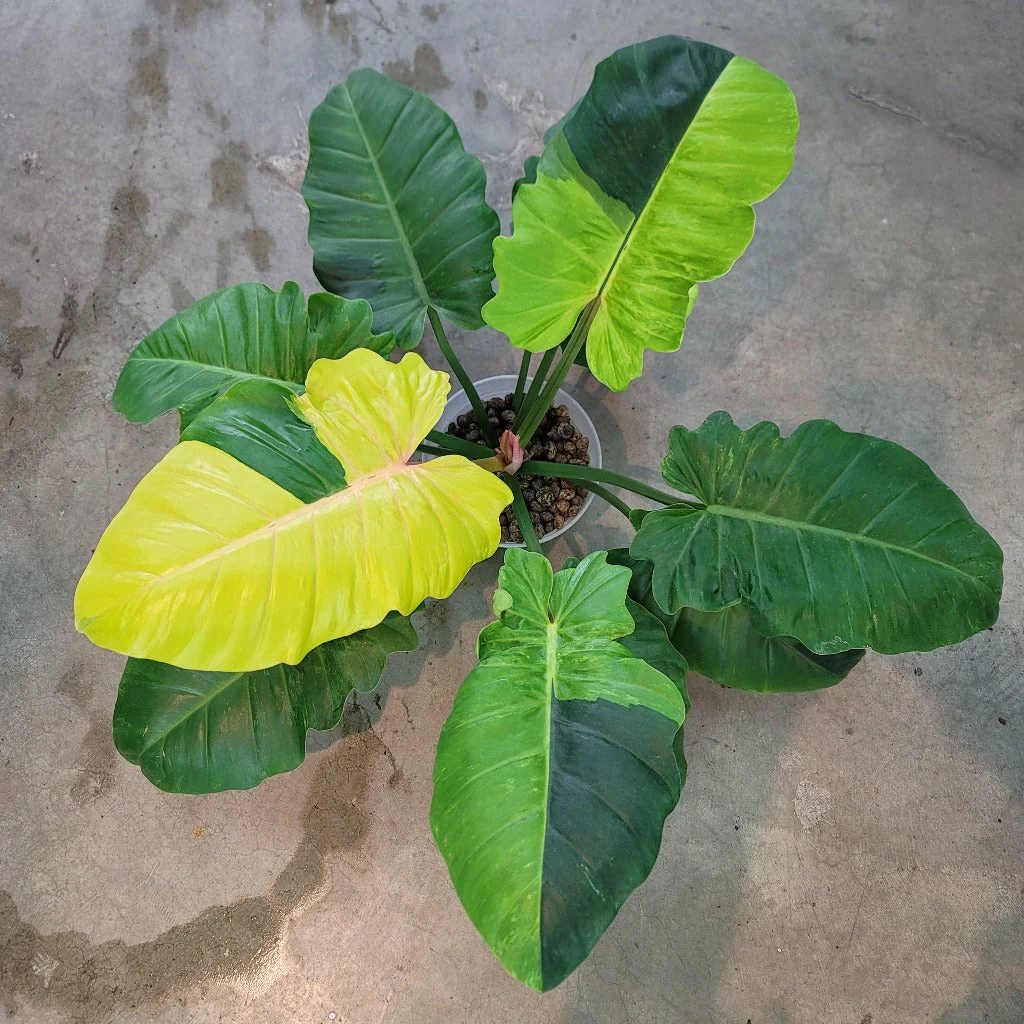
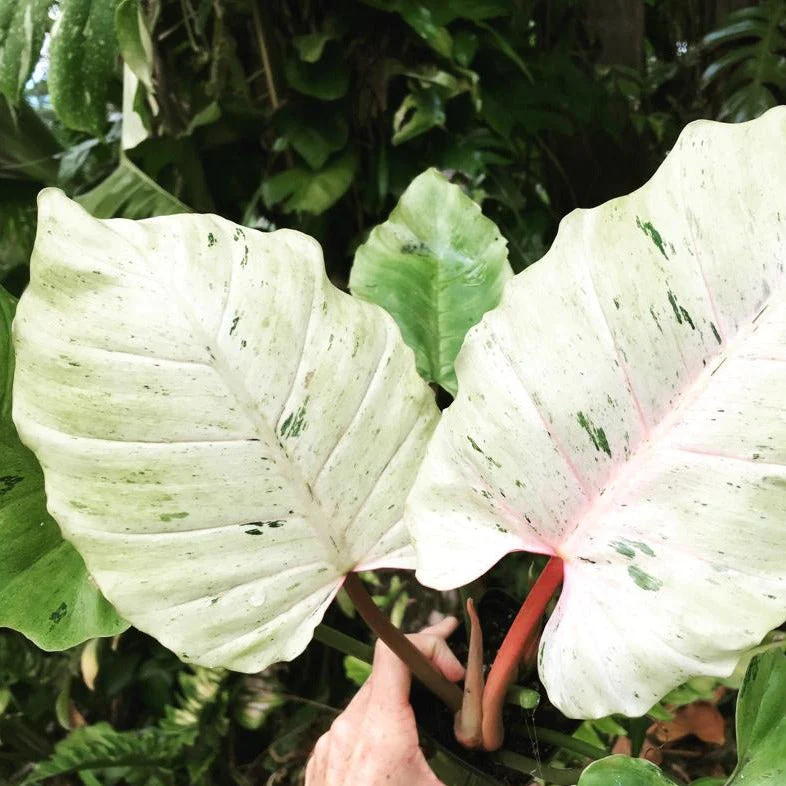
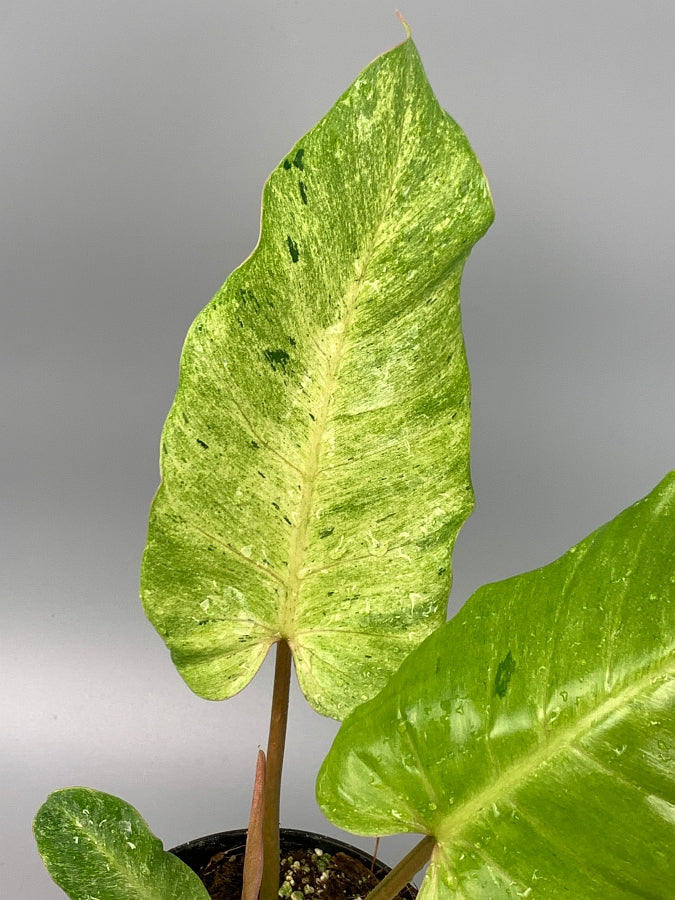
Image source: Internet (Please contact us if you find any copyright infringement)
Philodendron Snowdrift
Note: The above information is only relative, the living conditions of the tree also depend a lot on other objective factors.
How to grow and care for Philodendron Snowdrift
Difficulty of growing Philodendron Snowdrift

Difficulty: 2-3/6
Philodendron plants are suitable for people with little experience because:
✅ Easy to adapt to indoor environment
✅ No need to water regularly
✅ Easy to propagate from cuttings with aerial roots
Soil for planting Philodendron Snowdrift
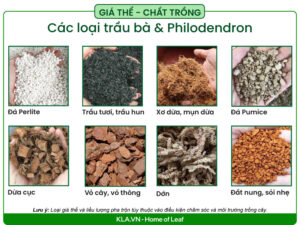
Philodendron Snowdrift plants need loose, well-draining soil that retains a slight amount of moisture.
The ideal Philodendron Snowdrift growing mix should contain ingredients that promote healthy root growth and prevent waterlogging.
📌 Recommended soil formula: ✅ 1 part humus or light loam
✅ 1 part coconut fiber/peat moss
✅ 1 part perlite or burnt rice husk
✅ 1 part rotten bark or pumice
🚫 Do not use soil that retains water for a long time or is compacted.
💡 Note:
- If you're growing Philodendron in a pot, make sure there are drainage holes at the bottom of the pot.
- You can apply organic fertilizer (worm castings, fish fertilizer, or slow-release fertilizer) once or twice a month to promote strong plant growth.
Suitable lighting for Philodendron Snowdrift

📌 Lighting details:
✅ Best: Place the plant near an east- or west-facing window where it receives diffused light. Thin curtains can be used to reduce the intensity of direct sunlight.
✅ Tolerant: Can tolerate weaker light for short periods, but the leaves will become smaller, paler in color, and growth rate will be slower.
🚫 Absolutely avoid:
-
Direct, intense sunlight, especially at midday, can cause leaf burn, resulting in dry brown spots along the edges of the leaves.
-
Do not place close to glass doors without curtains if the house faces South or Southwest.
💡 Special Note:
-
If the new leaves are small, misshapen, or deformed, the plant may be lacking sunlight.
-
If you must place the plant in a dimly lit area (such as a windowless room), you can use LED grow lights placed about 30–40 cm away from the plant and illuminated for 10–12 hours each day.
📍 Ideal location in the house:
-
There are light curtains or light-filtering screens near the windows.
-
If the window faces south, place the plant about 1–1.5 meters away from the window or use curtains to diffuse the light.
-
Do not place near hot light sources (such as halogen bulbs) that cause heat.
The ideal temperature for Philodendron Snowdrift

🌿 Ideal temperature for Philodendron Snowdrift: 18 - 27°C
📌 Features:
-
As a tropical plant, Philodendron Snowdrift prefers a warm, humid climate.
-
Cannot tolerate cold or sudden temperature changes.
As a tropical plant, Philodendron Snowdrift prefers a warm, humid climate.
Cannot tolerate cold or sudden temperature changes.
🚫 Temperatures below 12°C can cause the plant to suffer from heat shock, resulting in drooping, yellowing, or shedding leaves.
🚫 Extremely high temperatures (>32°C) without sufficient humidity also cause leaves to wilt quickly and develop brown burn marks.
📌 Note for healthy plant growth:
✅ Avoid strong drafts, especially from air conditioners, high-powered fans, or windows that are open at night.
✅ Do not place the plant near heaters, stoves, or areas with significant temperature fluctuations.
✅ During hot days, increase humidity by: Placing the pot on a tray of water with pebbles, lightly misting the leaves in the early morning, or using a humidifier if the room has regular air conditioning.
📍 Signs of plants affected by temperature:
🚫 Too cold:
-
Leaves droop, soften, turn yellow.
-
Roots do not absorb water even when the soil is moist.
🚫 Too hot & dry:
-
The leaves are withered but the soil is still moist.
-
The edges of the leaves are dry, brittle and curled inward.
Watering for Philodendron Snowdrift plants

Philodendron Snowdrift originates from the tropical forests of South America, so it prefers slightly moist soil but cannot tolerate waterlogging. Proper watering will help the plant grow healthily and maintain its characteristic large leaf size.
📌 Watering principles:
✅ Water thoroughly until water drains from the bottom of the pot to ensure the roots below receive adequate water.
✅ Check soil moisture before watering by poking your finger into the top 2–3 cm of soil or using a moisture test strip. Only water when the soil surface begins to dry out.
✅ Reduce watering frequency during cold weather or when the plant is growing slowly. In winter, only water when the soil is completely dry.
🚫 Avoid overwatering – easily recognizable signs include pale yellowing leaves, wilting, or mold appearing on the soil surface, indicating root rot and potential root decay.
📍 How many times a week should I water?
-
During the hot season (spring and summer): 1–2 times per week, depending on lighting and humidity conditions.
-
Cold season (autumn-winter): every 7–10 days or longer if the soil retains moisture for a long time.
-
If growing aquatic plants (less common but feasible): Change the water 1–2 times/week; use activated carbon to keep the water clean and prevent algae growth.
Humidity for Philodendron Snowdrift

Philodendron Snowdrift thrives best in high humidity environments of 60% or higher. In dry conditions or with air conditioning, the plant may experience leaf burn, curled leaves, or stunted growth.
📌 How to maintain proper humidity:
✅ Lightly mist the leaves daily, especially in the morning – this helps increase humidity, but avoid wetting the leaves too much in the evening to prevent fungal diseases.
✅ Place the plant on a tray of pebbles filled with water; the evaporating water will create micro-humidity around the plant pot.
✅ Use a humidifier in enclosed rooms or when using air conditioning frequently.
✅ Plant tropical trees in groups to create a natural microclimate effect with higher humidity around the canopy.
The ideal pH level for Philodendron Snowdrift

Philodendron Snowdrift thrives in soil with a slightly acidic to neutral pH, specifically within the range of... 5.5 – 7.0.
🌿 If the soil pH is too low (below 5.5), plants may have difficulty absorbing essential nutrients, especially calcium (Ca) và Magnesium (Mg)This can result in weak leaves, yellow leaf edges or premature necrosis.
🌱 If the soil pH is too high (above 7.0), plants are prone to iron (Fe) deficiency – causing young leaves to turn yellow while the veins remain green (iron deficiency yellowing disease). Plants may also poorly absorb micronutrients such as manganese (Mn) and copper (Cu), slowing down their growth.
💡 Care tips:
-
You should use a soil pH test kit every 1-2 months to monitor the pH level.
-
If pH is too low: Can add more dolomite lime into the soil to slightly raise the pH.
-
If the pH is too high: You can mix in decomposed sawdust, compost, or sphagnum moss to naturally lower the pH.
Pet-friendly

Philodendron Snowdrift contains needle-shaped calcium oxalate crystals – a compound that causes severe irritation in the mouth, throat, and digestive system of dogs, cats, and other pets if they chew on the leaves or stems.
⚠️ Symptoms if your pet ingests this:
-
Drooling, vomiting, difficulty swallowing
-
Mouth swelling, sore tongue, may bleed slightly
-
Loss of appetite for several hours to several days
🚧 Preventive measures:
-
Place the plant high up, out of reach of pets.
-
Use a cage, screen or anti-bite spray if you have curious cats or dogs.
💡 Additional notes for Philodendron Snowdrift growers:
💡Plants can “cry” (guttation – secretion at the edge of leaves) at night if the soil is too wet or the air humidity is high, this is a normal physiological reaction.
💡This plant thrives in strong sunlight, so rotate the pot every 1–2 weeks to help it grow evenly on both sides.
💡If you see brown spots, whiteflies, or mold on the leaves, clean them with a diluted soap solution or pure neem oil.
💡Want breeding? Cut a piece of the body aerial roots, Then, plant it in clean water or moist growing medium – new roots will grow after 2–3 weeks.
💡Use coconut fiber stakes or moss supports for the plant to climb on – this helps the plant produce larger, thicker, and more beautiful leaves.

Indoor Plant Care Guide
The most important and basic knowledge about growing plants indoors:
Content is subject to content moderation by Long Hồ – Founder, Senior Plant Copywriter, Gardener
Learn about Chính sách biên tập From KLA Garden. You can contact us to write articles or create content; payment will depend on the quality of your content. Contact Long Ho: hofilong@gmail.com.